
How many hours a week does your senior firmware engineer spend on code review?
In most automotive electronics and semiconductor equipment teams, the answer is: more than they can afford to spend. Junior engineers stack up PRs waiting for review. Senior engineers’ calendars get carved apart by review meetings. The architectural discussions and customer technical support that actually need their expertise get pushed to evenings.
This isn’t a people problem — it’s a structural problem. Traditional code review is a linear bottleneck: only senior engineers can do it, and senior engineers’ time is finite.
In 2026, AI code review tooling has matured to the point where it can resolve this structural bottleneck — not by replacing human reviewers, but by filtering before human review happens. Senior engineers’ attention goes where it’s actually needed.
Why Embedded Firmware Code Review Is Uniquely Hard
Application-layer code review and embedded firmware code review are not the same discipline. The embedded context introduces challenges that don’t exist in web or cloud software:
- Hardware coupling: Code correctness depends on chip-specific register behavior, timing constraints, and interrupt priority schemes — context that static analysis tools don’t natively understand
- MISRA / AUTOSAR compliance: Automotive firmware must conform to MISRA C/C++ coding standards; every deviation requires documented justification, making review expensive
- Memory safety without a safety net: No garbage collector, no exception handling — stack overflows, use-after-free bugs, and race conditions only manifest on target hardware. Code review is the only pre-silicon defense
- Cross-team integration: A single ECU may receive code from multiple suppliers simultaneously, with inconsistent styles and different architectural assumptions
These constraints mean embedded code review requires deep domain knowledge. A web developer can’t cover it. This is why it depends so heavily on the handful of senior firmware engineers on any given team.
What AI Code Review Can Do in Embedded Contexts
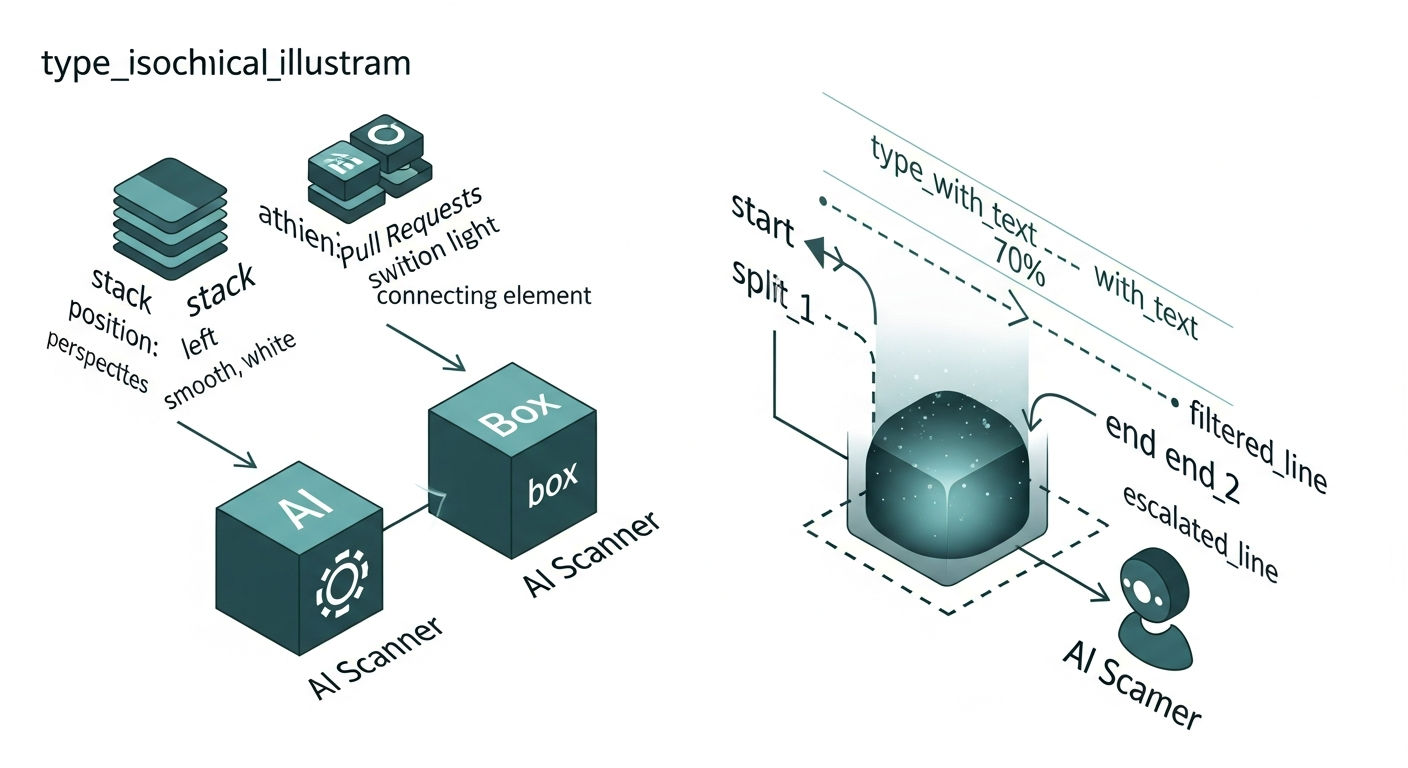
Here is what AI code review tooling can reliably deliver in 2026:
1. Style and Standard Conformance
LLM-assisted tools can automatically flag deviations from your coding standard — including MISRA subsets — at PR submission. This class of review accounts for 30–40% of senior engineer review time and is fully automatable.
2. Common Defect Pattern Detection
AI tools can identify, without executing the code:
- Uninitialized variables and out-of-bounds access patterns
- Non-atomic operations inside interrupt service routines
- Obvious null dereference paths
- Resource leaks (memory, file handles, mutexes)
3. PR Summarization and Context Reconstruction
AI can automatically generate a structured summary for every PR — what changed, why, and where the risk is — so senior engineers arrive at human review with a global view rather than spending the first fifteen minutes reading diff to understand intent.
4. Historical Defect Comparison
If you have past bug reports and fix histories, AI can compare incoming PRs against that record and flag patterns: “this looks like the CAN bus race condition from Q3 2024.” This kind of institutional knowledge is exactly what gets lost when senior engineers leave.
What AI Cannot Do: Judgment Remains Human
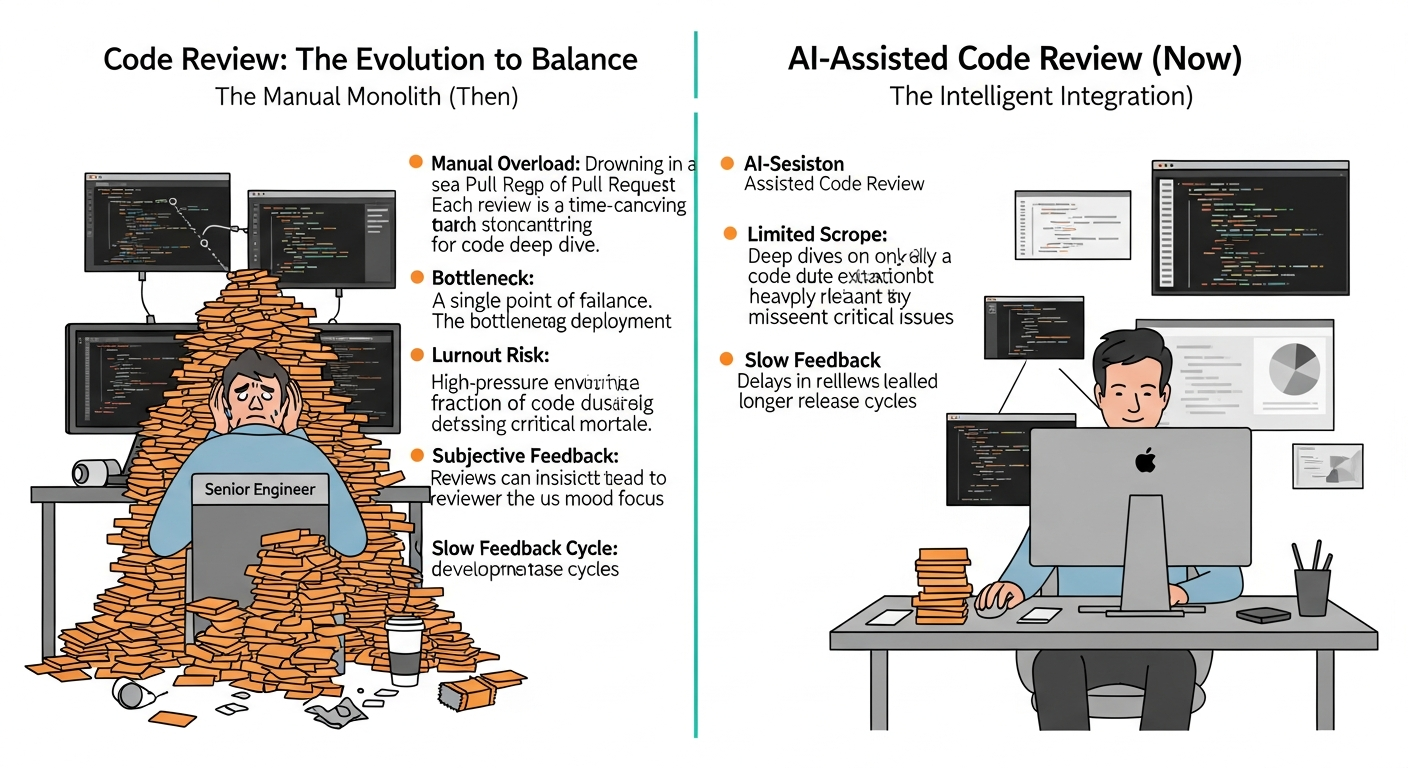
This boundary matters. AI code review is not reliable for:
- Architectural decisions: Whether a design is safe under RTOS context switching requires understanding full system behavior — that’s judgment, not pattern matching
- Requirements correctness: Does this code match the SRS specification? AI can’t read your requirements documents unless you’ve built a RAG knowledge base around them
- New hardware platform behavior: Silicon errata and undocumented edge cases on unfamiliar chips require hardware-informed intuition that AI doesn’t have
- Safety-critical sign-off: ASIL-B/C/D safety arguments require human accountability and human signatures — not because AI is unreliable, but because the regulatory framework requires human responsibility
The correct mental model is not “AI replaces code review” — it’s “AI runs the first pass, humans run the final judgment.” This division of labor shifts senior engineers from reviewing all PRs to reviewing the PRs that actually warrant their expertise.
Implementation Path: Where to Start
For automotive Tier-1 or semiconductor equipment teams, the recommended sequence is:
- Start with a low-risk repository: Don’t begin with your most safety-critical module. Pick a non-ASIL utility library, run AI review through a few sprints, and observe false positive rates and coverage
- Build a feedback loop: Have senior engineers label AI-flagged issues as true positive or false positive. Use that signal to tune prompts and rule sets continuously
- Integrate into CI: Make AI review a required gate before human review. Human review addresses only what AI couldn’t determine
- Load historical defects into a knowledge base: Indexing past bug reports into a RAG system gives AI comparison context. This step has the highest upfront investment and the highest long-term return
KPO Model: AI Code Review as an Outsourced Service
If your team doesn’t have internal bandwidth to build this pipeline, KPO outsourcing is the alternative.
How this works in practice:
- AQUANEST builds and maintains the AI code review pipeline: tool selection, prompt engineering, CI integration
- Senior embedded engineers provide the second-layer human review for high-risk PRs flagged by AI
- Weekly review reports: defect classification, trend analysis, recurring pattern recommendations
- GMT+8 timezone — firmware your engineers push in the morning gets reviewed before end of day. Same-timezone turnaround keeps sprint cadence tight
Compare this to offshore review services based in Europe or the US: 6–8 hours of timezone lag means waiting until the next day for review results. When embedded iteration cycles are short, that lag compounds directly into slower sprint velocity.
Further reading: ODC vs KPO vs BPO: Which Outsourcing Model Is Right for You
Conclusion: Senior Judgment Is a Scarce Resource
Embedded firmware quality ultimately depends on the judgment of a small number of senior engineers. That judgment is scarce — it can’t be manufactured by working longer hours, and it can’t be substituted with headcount.
The value of AI code review is not eliminating senior engineers from the process. It’s ensuring their time goes to work that actually requires their judgment — real architectural risk, cross-module dependencies, safety-critical paths. Everything else, let AI see first.
If your firmware team is dealing with review backlog, inconsistent quality, or senior engineers drained by routine PR processing, contact AQUANEST to discuss how AI code review KPO can address the bottleneck.