

If you’re a CTO or engineering leader in 2026, you’ve probably noticed the same uncomfortable trend: senior engineering salaries keep climbing, recruitment timelines keep stretching, and the cost of every additional headcount is forcing harder trade-offs against your roadmap. The question isn’t whether to reduce software development cost — it’s how to do it without slowing down your product.
The good news: companies that adopt the right offshore model routinely cut their engineering spend by 50–65% while shipping faster than their in-house-only competitors. The bad news: most companies that try and fail do so for predictable, avoidable reasons.
This guide breaks down exactly where the savings come from, what the real numbers look like in 2026, and how to capture the upside without falling into the common offshore traps.

The Real Cost of an In-House Engineer in 2026
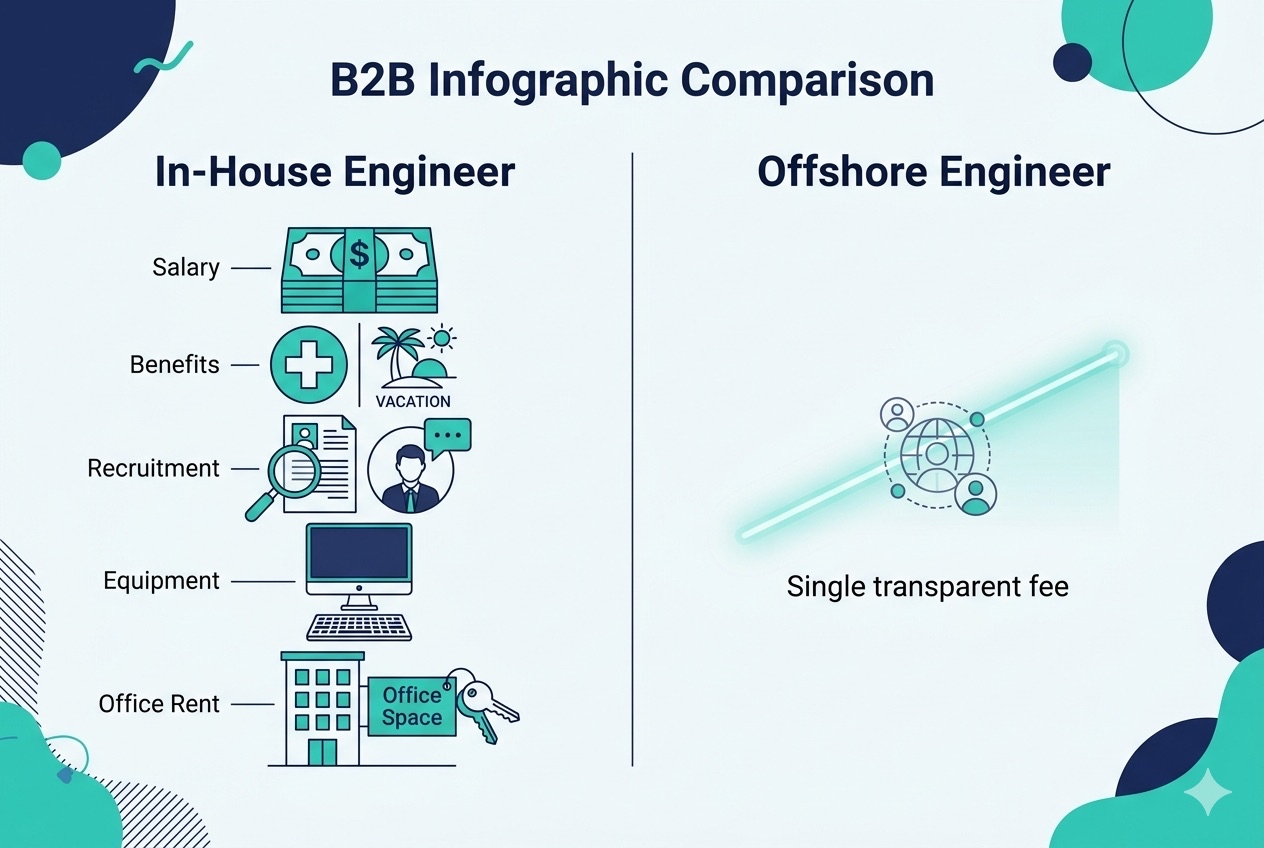
Before we talk about savings, let’s anchor the comparison. Most cost analyses underestimate the true loaded cost of a senior engineer because they only count base salary. The full picture looks more like this:
Total Cost of a US-Based Senior Software Engineer
- Base salary: $160,000–$220,000
- Benefits and payroll taxes: +25–35% loaded cost
- Equity dilution: 0.05–0.25% per senior hire
- Recruitment fees: $20,000–$40,000 per successful hire
- Onboarding and ramp-up: 3–6 months at reduced productivity
- Equipment, tools, and office overhead: $8,000–$15,000/year
- Attrition risk: 18–24% annual turnover in tech
The fully loaded annual cost of one senior engineer in a major US tech market routinely exceeds $280,000. In Western Europe, the equivalent number sits around $200,000–$240,000. And these numbers don’t include the opportunity cost of a 4–6 month hiring cycle while your roadmap stalls.
Where the 60% Savings Actually Come From
When companies report “60% cost savings” from offshore software development, they’re not just citing salary arbitrage. The savings stack across five categories:
1. Direct Labor Cost Differential
A senior engineer in Taiwan, Vietnam, or the Philippines with comparable skill levels typically costs 40–55% less than a US equivalent — even after accounting for the offshore partner’s margin. This is the most visible saving but often the smallest piece of the total.
2. Eliminated Recruitment and Onboarding Costs
A mature offshore partner deploys vetted engineers within 2–4 weeks. You skip the $20,000–$40,000 recruitment fee, the 4-month hiring cycle, and the 3-month ramp-up period. For a 5-engineer team, this alone saves $200,000+ in the first year.
3. Reduced Overhead
No additional office space, no equipment provisioning, no benefits administration, no compliance overhead. The offshore partner handles all of it.
4. Faster Time-to-Market
Counterintuitively, offshore teams often ship faster — not because individual engineers are faster, but because you can scale up immediately instead of waiting two quarters to staff a project. Faster ship dates compound into earlier revenue and reduced runway burn.
5. Flexibility Cost Savings
You can scale a dedicated development team up or down based on project phases. In-house engineers are fixed costs; offshore engineers can be variable. For seasonal or project-based work, this single dimension can save 30% over a year.
Offshore Team vs In-House Engineers Cost: A Real Example
Let’s run the numbers for a realistic scenario: a 5-engineer team building an embedded software product over 18 months.
Scenario A: All In-House (US Market)
| Cost Item | Annual | 18-Month Total |
|---|---|---|
| 5 × Senior engineer (loaded $280K) | $1,400,000 | $2,100,000 |
| Recruitment fees (5 hires) | — | $150,000 |
| Onboarding productivity loss | — | $175,000 |
| Equipment & office overhead | $60,000 | $90,000 |
| Attrition replacement (~20%) | — | $200,000 |
| Total | $2,715,000 |
Scenario B: Offshore Dedicated Team (KPO Model)
| Cost Item | Annual | 18-Month Total |
|---|---|---|
| 5 × Senior engineer (loaded $95K) | $475,000 | $712,500 |
| Recruitment fees | $0 | $0 |
| Onboarding productivity loss | — | $30,000 |
| Equipment & office overhead | $0 | $0 |
| Attrition replacement | — | Included in partner SLA |
| Total | $742,500 |
Total savings: $1,972,500 over 18 months — a 73% reduction.
Even if you discount these numbers conservatively for productivity differences (which we’ll address in a moment), the realistic savings range still lands between 55–65%.
“But Won’t We Lose Quality?” — Addressing the Real Concerns
The single biggest objection to offshore engineering is quality. It’s a fair concern — and the answer depends entirely on which offshore model you choose.
Body-Shop Outsourcing: Where Quality Concerns Are Justified
Traditional staff augmentation firms compete on price, churn through engineers, and rarely understand your domain. If your offshore experience came from this model, your skepticism is earned.
KPO and Dedicated Team Models: A Different Class
A modern KPO partnership works fundamentally differently. You get senior engineers who stay on your project for the duration, integrate into your tooling and processes, and bring deep domain expertise — particularly in embedded systems, automotive software, and industrial IoT.
The quality gap closes — and in many cases reverses — when you compare a senior offshore KPO engineer (working exclusively on your product, with deep domain experience) to a mid-level in-house engineer hired hastily because senior talent was unavailable.
The Five Most Common Offshore Cost Mistakes
Companies that fail to capture the projected savings usually make at least one of these errors:
1. Choosing on Hourly Rate Alone
The cheapest hourly rate often delivers the most expensive result. Hidden costs emerge as rework, missed deadlines, and integration failures. Evaluate total cost of ownership — not the line-item rate.
2. Skipping the Discovery Phase
Companies that rush into engagement without aligning on architecture, deliverables, and quality gates pay for it in the first three months. A two-week structured discovery saves months downstream.
3. Treating Offshore as a Black Box
The best offshore engagements feel like an extension of your team — daily standups, shared tooling, joint retrospectives. The worst feel transactional, with status reports replacing collaboration.
4. Underinvesting in Knowledge Transfer
Two weeks of structured knowledge transfer at the start saves six months of misaligned execution. Skip this step at your peril.
5. Not Defining Clear IP and Security Boundaries
Top-tier offshore partners offer signed IP assignments, ISO 27001 compliance, and physical security guarantees. If your partner doesn’t, you’re carrying risk you don’t need to carry.
How to Capture the Full 60% Savings: A Practical Playbook
Step 1: Audit Your Current Cost Stack
Calculate your fully loaded engineering cost — including recruitment, attrition, ramp-up, and overhead. Most companies discover their actual per-engineer cost is 40–60% higher than they assumed.
Step 2: Identify the Right Workload
Not every project belongs offshore. Best candidates: well-scoped product modules, embedded firmware, QA automation, sustained engineering, platform services. Risky candidates: greenfield architecture decisions, customer-facing UX iteration, anything tightly bound to a specific in-house engineer’s tacit knowledge.
Step 3: Choose the Right Engagement Model
For most tech companies, a dedicated development team under a KPO model delivers the best balance of cost, speed, and quality. For long-term commitments at scale, transitioning to an ODC adds further savings — see our breakdown on ODC vs KPO vs BPO.
Step 4: Run a 90-Day Pilot
Don’t commit to a multi-year contract until you’ve validated the working relationship. A well-designed 90-day pilot — with clear deliverables and a “go/no-go” exit clause — derisks the entire engagement.
Step 5: Build a Hybrid Operating Model
The companies extracting maximum value don’t outsource everything — they keep architecture, product strategy, and customer-facing roles in-house, then leverage offshore teams for execution-heavy and specialized work. This hybrid model captures the savings without losing strategic control.

Why Tech Companies Are Choosing Taiwan for Offshore Engineering
Taiwan has emerged as one of the most strategically valuable offshore destinations in 2026 — particularly for hardware-adjacent software work. The country’s deep semiconductor and electronics manufacturing ecosystem produces engineers who genuinely understand the hardware-software intersection, which is increasingly rare in pure-software offshore markets.
For embedded systems, ADAS, smart cockpit, industrial IoT, and any product where software meets silicon, Taiwan offers a talent pool with directly relevant experience that costs 50–60% less than equivalent talent in the US, while sharing English-language business norms and Asia-Pacific time zone alignment with most APAC customers.
Conclusion: Cost Reduction Is a Strategy, Not a Tactic
Cutting development costs by 60% isn’t about finding cheaper engineers — it’s about restructuring how your engineering organization operates. The companies that succeed treat offshore not as a procurement decision but as a strategic capability: building hybrid teams that combine in-house leadership with offshore execution depth.
Done well, this approach doesn’t just save money. It accelerates your roadmap, reduces hiring risk, and frees your in-house engineers to focus on the work where they create the most differentiated value.
If you’re ready to evaluate whether offshore can deliver the cost reduction your roadmap needs — without the typical pitfalls — AQUANEST’s team can walk you through a customized cost model based on your actual stack, headcount, and roadmap.
See What 60% Cost Reduction Looks Like for Your Team
Share your current engineering setup and we’ll model the transition — covering savings, ramp-up timeline, and risk mitigation. No commitment, no sales pressure.
Frequently Asked Questions
How much can I realistically save with an offshore software team?
Most companies save 40–60% on total engineering costs when moving to an offshore KPO or ODC model. Savings come from lower base salaries, reduced overhead, no recruitment costs, and faster ramp-up compared to in-house hiring.
What is the typical cost difference between onshore Taiwan and offshore engineers?
A mid-level software engineer in Taiwan costs roughly NT$80,000–120,000/month in salary alone, plus 30–40% in overhead. A comparable offshore KPO engagement often runs NT$40,000–60,000/month all-in, with no recruitment or attrition risk.
How long does it take an offshore team to get up to speed?
With structured onboarding, an offshore KPO team typically reaches full productivity within 4–8 weeks. AQUANEST’s AI-augmented onboarding (knowledge base pre-population, process documentation) cuts this ramp-up time significantly.
What are the biggest risks with offshore software development, and how do you manage them?
The main risks are quality inconsistency, communication gaps, and IP security. AQUANEST mitigates these with senior engineer oversight, bilingual project management, secure dev environments, and NDA-first engagements. Start at https://aqnest.com/#contact.