

You’ve found an embedded firmware engineer in Taiwan. The technical fit is right, the compensation range is aligned. The only problem: your company doesn’t have a Taiwan legal entity.
The obvious next step is to spin up a Deel or Remote contract. Both platforms are fast to set up, offer clean interfaces, and handle standard payroll compliance. But if your engineer needs to access CAN bus hardware, work with AUTOSAR toolchains, or run validation tests on customer-provided equipment at a Tier-1 facility — you’ll quickly realize these platforms were built for remote workers, not on-site embedded engineers.
This guide focuses on cross-border engineer hiring in Taiwan, specifically for embedded systems and automotive software roles. We’ll break down where global EOR platforms hit their limits, what Taiwan-local EOR actually provides, and when KPO is the better alternative to EOR altogether.
The Three Ceilings of Global EOR Platforms
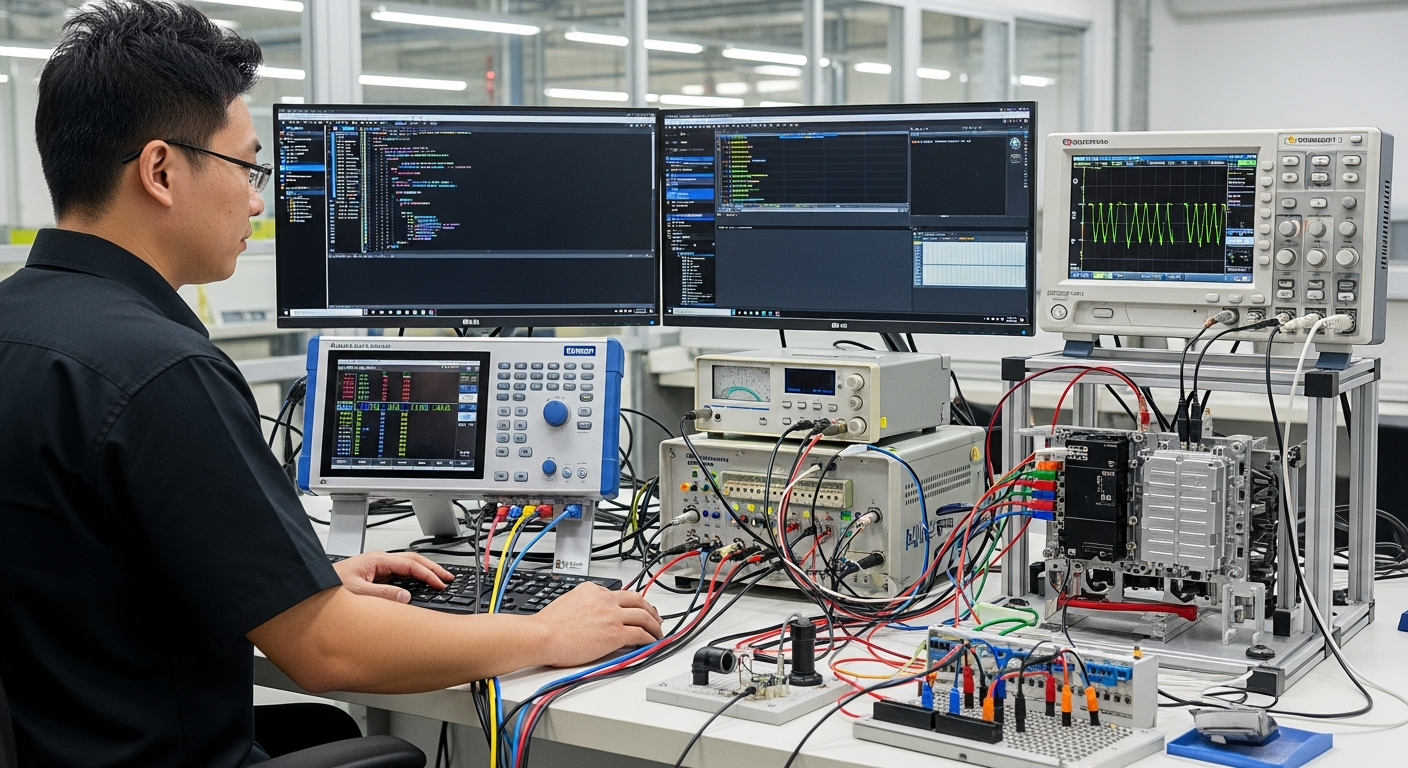
Deel and Remote work well for marketing, design, and full-stack web engineers — roles where the work can be done anywhere with a laptop. Embedded and automotive software engineers operate differently:
- On-site validation at customer facilities with Vector CANalyzer and oscilloscopes
- ECU flashing and testing in cleanroom environments
- Hardware-in-the-loop (HIL) validation at Tier-1 test benches
- Face-to-face FMEA reviews with mechanical engineering teams
These workflows cannot be fully remote. Global EOR platforms are designed around the assumption that your engineer can work from anywhere. For automotive software, that assumption is simply wrong.
Ceiling 1: No Framework for On-Site Deployment
Standard Deel/Remote contracts define employment as remote work. When an engineer needs to spend 10+ days per month at a customer facility, the legal classification shifts — from remote worker to on-site service provider. Global platforms lack the contractual flexibility to handle this cleanly, which creates compliance ambiguity for both employer and engineer.
Ceiling 2: IP Clauses Designed for Pure Software
Embedded project IP is complex: Who owns the firmware? Who owns the customized RTOS? How is the hardware abstraction layer (HAL) scoped between vendor IP and contractor IP? Deel/Remote’s standard IP agreements are built for software-as-a-service contexts. They’re not designed to handle the hardware-software IP boundary that embedded and automotive projects involve.
Ceiling 3: No Technical Support Presence in Taiwan
Taiwan’s automotive and semiconductor supply chain runs on local relationships — phone confirmations, on-site meetings, Chinese-language technical documentation. Global EOR platforms have Taiwan-based payroll and legal staff. They can handle labor insurance. They cannot help when your engineer is locked out of a customer facility or when a NDA clause needs to align with a specific chipmaker’s IP policy.
What Taiwan-Local EOR Actually Provides
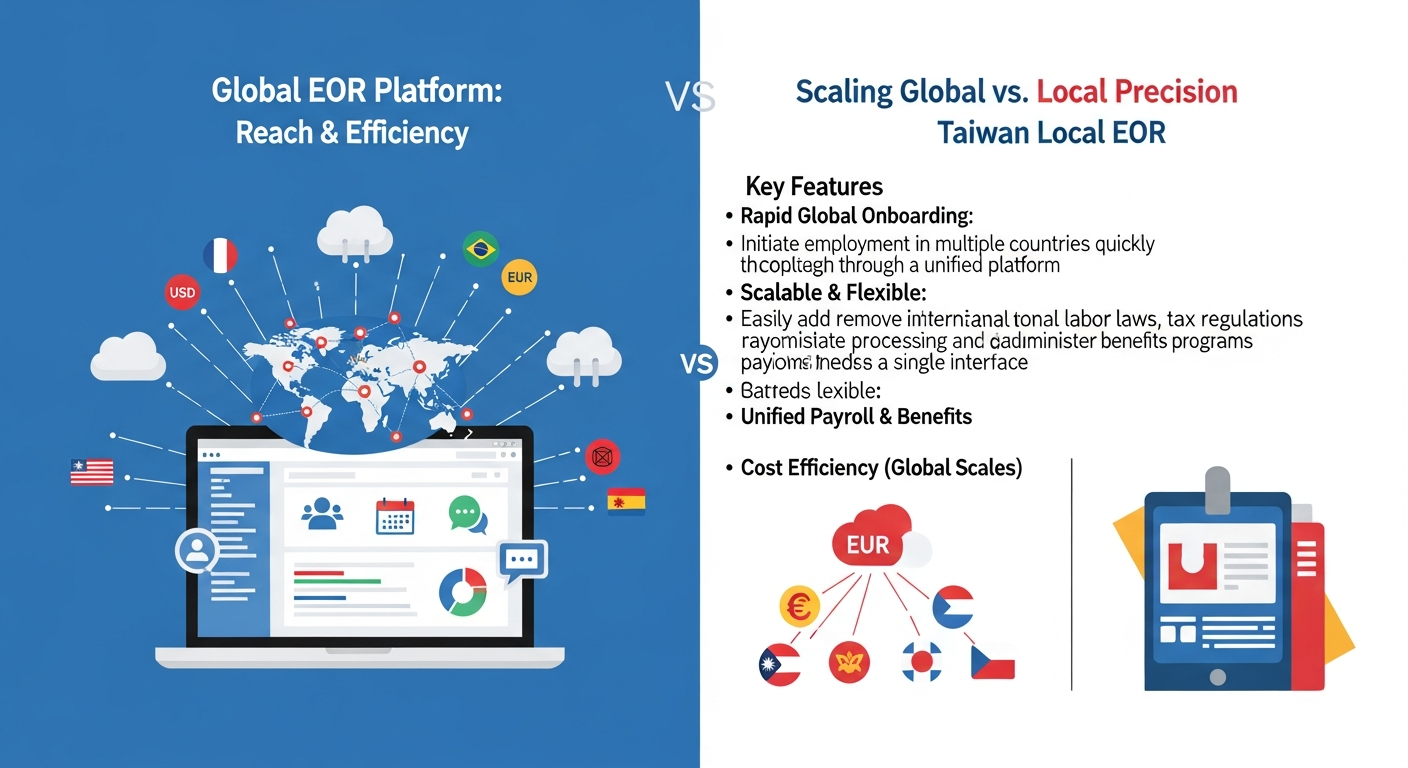
A Taiwan-based EOR goes beyond compliance administration. For embedded and automotive roles, the critical differentiators are operational, not just legal.
Advantage 1: Full Taiwan Labor Compliance — Not Just Payroll
Taiwan’s labor system runs three parallel schemes: Labor Insurance, National Health Insurance, and Labor Pension (Labor Standards Act Section 6). Calculating contributions correctly requires local expertise, not a generic calculator. Beyond payroll, Taiwan’s Labor Standards Act has specific provisions around severance calculation, mandatory paid leave, and non-compete enforceability — standard global templates often don’t comply.
Advantage 2: On-Site Deployment Contracts That Actually Work
When an engineer needs a 12-week on-site deployment at a Tier-1 facility for system integration validation, Taiwan-local EOR can structure the engagement correctly — balancing the engineer’s employment status, the client NDA requirements, and any secondary IP considerations from the facility owner. This is a standard business scenario in Taiwan’s automotive supply chain. It’s outside the scope of global platform templates.
Advantage 3: IP Agreements Built for Hardware-Software Projects
Embedded software IP protection requires legal counsel that understands the technical context. Which components are original development? Which are derived from customer-provided IP? Which open-source licenses apply? Taiwan-local EOR can engage technical legal advisors to draft NDA terms, IP ownership clauses, and non-compete agreements specific to the engagement — not a translated English template.
EOR vs. KPO: Decision Framework for Embedded Roles
If you’ve already reviewed our EOR vs. KPO vs. Staffing comparison guide, you have the basic framework. Here’s the embedded-specific decision logic:
| Your Situation | Recommended Model | Why |
|---|---|---|
| Found a specific engineer you want to hire directly | EOR | You select; EOR handles compliance |
| Need a 3–8 person embedded team for a defined deliverable | KPO / ODC | Buy team capability, not headcount management |
| Engineer needs long-term on-site deployment at customer facility | EOR + on-site deployment clause | Local EOR can structure the deployment contract correctly |
| Budget-constrained, need one test automation engineer | KPO (single-engineer ODC) | KPO can be scoped to a single role with tooling included |
| Want to pilot before committing to full employment | KPO trial → EOR conversion | Validate fit via KPO, convert to direct hire via EOR |
How AQUANEST Approaches Cross-Border Engineering Hires
AQUANEST provides Taiwan-local EOR, but the difference from Deel/Remote is structural: we are an engineering services company that offers EOR as part of a broader engineering engagement model.
- Technical vetting before placement: Our engineering leads evaluate candidates against actual embedded/automotive requirements — not a generic software engineering rubric
- Domain fluency: When you say you need an engineer with AUTOSAR Classic Platform experience, we don’t ask what that means
- On-site management coverage: During customer facility deployments, AQUANEST’s local team is available to handle field issues — access, equipment coordination, NDA-related logistics
- EOR ↔ KPO flexibility: If you start with KPO and want to convert a specific engineer to direct EOR hire, we have a defined transition path
The Taiwan Embedded Engineer Market in 2026
A common assumption among international clients: Taiwan engineers are affordable. For embedded automotive roles in 2026, this is partially incorrect.
Median compensation for embedded engineers in Taipei/Hsinchu:
- 3–5 years experience: NT$65,000–90,000/month (approx. USD 2,000–2,800)
- 5–8 years (AUTOSAR / ISO 26262 experience): NT$90,000–130,000/month (approx. USD 2,800–4,100)
- Senior 10+ years (system architect): NT$140,000–200,000+/month
Total employer cost including labor insurance, pension, and EOR service fees typically runs 1.2–1.35× base salary. The gap with European or North American rates remains significant, but the era of “low-cost Taiwan embedded engineers” in automotive is over.
More important: experienced automotive software engineers in Taiwan are a scarce resource. TSMC, MediaTek, and Foxconn’s EV division are all recruiting from the same talent pool. If you plan to hire directly via LinkedIn using a global EOR platform, you’re competing against Taiwan’s best-resourced companies. A local EOR partner with an existing engineering network reaches candidates who aren’t actively job-searching.
A Real Scenario
A European Tier-2 automotive module manufacturer needed to hire two embedded software engineers in Taiwan to work on BSP (Board Support Package) development in collaboration with a local chipmaker. Their initial approach used a global EOR platform. Two problems emerged:
- The standard contract couldn’t accommodate the engineers’ 8–10 days per month on-site requirement at the chipmaker’s facility
- The IP clause template was written for generic SaaS software — it couldn’t differentiate between chipmaker IP, customer IP, and contractor-developed BSP components
Switching to Taiwan-local EOR resolved both issues at the contract drafting stage — through technical legal consultation specific to the BSP collaboration structure, not template substitution. After the engineers went live, the local EOR team handled on-site coordination including access protocols, equipment sign-out, and NDA logistics with the facility team.
Further Reading
If you’re still comparing EOR, KPO, and traditional staffing, see: EOR vs. KPO vs. Staffing: A CTO’s Guide to Hiring Software Engineers in Taiwan. For an overview of how AQUANEST’s KPO model integrates AI tools into engineering delivery, see the AQUANEST KPO service overview.
Next Step
If you’re evaluating cross-border hiring for embedded or automotive software engineers in Taiwan — whether EOR direct hire or KPO team engagement — contact AQUANEST for a 48-hour initial assessment. We’ll map your scenario to the right engagement model, with a cost estimate, compliance overview, and candidate qualification criteria.
Frequently Asked Questions
Why can’t global EOR platforms like Deel or Remote handle embedded automotive engineers in Taiwan?
Deel and Remote are designed for fully remote roles — marketing, design, full-stack web. Embedded automotive engineers regularly need on-site access to customer facilities, ECU test benches, CAN bus analyzers, and cleanroom environments. Global platform contracts define employment as remote work, which creates compliance ambiguity when engineers need 8–12 days per month at a Tier-1 client facility. Local Taiwan EOR can structure on-site deployment contracts that satisfy both labor law and client NDA requirements.
What does cross-border engineer hiring in Taiwan actually cost in 2026?
For embedded/automotive software engineers in Taipei or Hsinchu: 3–5 years experience costs NT$65,000–90,000/month base (approx. USD 2,000–2,800); 5–8 years with AUTOSAR or ISO 26262 experience costs NT$90,000–130,000/month (USD 2,800–4,100); senior architects 10+ years run NT$140,000–200,000+/month. Total employer cost including labor insurance (8.05%), NHI (3.10%), occupational accident (0.12%), pension (6%), and EOR service fee is typically 1.2–1.35× base salary.
How does Taiwan-local EOR handle IP protection for embedded software projects?
Embedded software IP requires technical legal context that generic EOR platforms cannot provide. A Taiwan-local EOR can engage technical legal advisors to draft NDA terms and IP ownership clauses that specifically address: which firmware components are contractor-developed versus client-provided, how BSP layers derived from chipmaker IP are classified, and what open-source license obligations apply. This is particularly critical for automotive ECU software where IP provenance affects ISO 26262 certification traceability.
Can Taiwan EOR support engineers who need to work at client facilities in Taiwan?
Yes — this is one of the key advantages of Taiwan-local EOR over global platforms. On-site deployment contracts can be structured to accommodate engineers spending defined periods at Tier-1 client facilities, with appropriate access protocols, secondary NDA arrangements, and equipment sign-out procedures. The EOR’s local team can coordinate facility access and handle the administrative logistics that global platforms cannot support from overseas.
What is the difference between hiring through Taiwan EOR versus setting up a Taiwan subsidiary?
Setting up a Taiwan subsidiary (branch office or local company) requires 2–4 months for registration, NT$500,000–1,000,000+ in setup costs, ongoing accounting/audit obligations, and a local director. EOR can have an engineer employed and compliant within 1–2 weeks, with zero entity setup cost. The trade-off: EOR carries a monthly per-employee service fee, and the engineer is technically employed by the EOR entity, not your company. For 1–5 engineers, EOR is almost always faster and cheaper; for 15+ engineers long-term, entity setup may be more economical.