
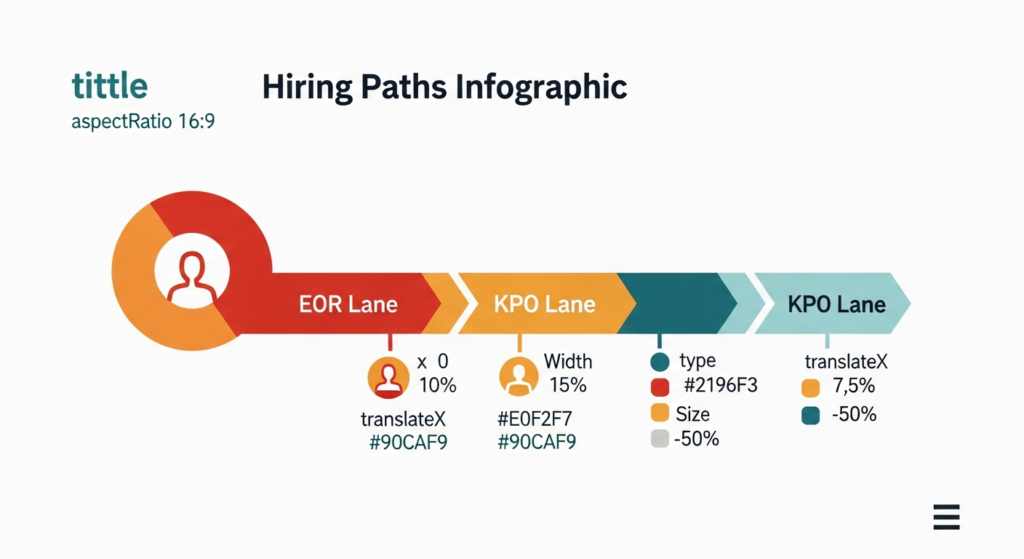
Taiwan’s software engineering salaries keep climbing. For CTOs in automotive electronics, semiconductors, and systems integration, the question isn’t whether to expand engineering capacity — it’s how. Three models dominate the conversation: EOR (Employer of Record) direct hire, KPO/ODC team outsourcing, and traditional staffing. Everyone in the market is selling one of them, but nobody’s telling you which one fits your specific situation.
This guide cuts through the noise. Read it, and you’ll know exactly which path suits your team.
Three Models at a Glance
| Model | What it is | What you get | What you manage |
|---|---|---|---|
| EOR (Employer of Record) | You select the engineer; a third party handles compliant employment | Direct hire of a specific engineer, no overseas entity required | Technical direction, task assignment, performance management |
| KPO / ODC | You buy team capability, not individual headcount | An engineering team with documented processes, knowledge base, and AI tooling | Requirements and acceptance criteria — not HR or staff turnover |
| Traditional Staffing | A recruiter fills seats | Contract workers or short-term contractors | Supervision, process, retention, and backfilling |
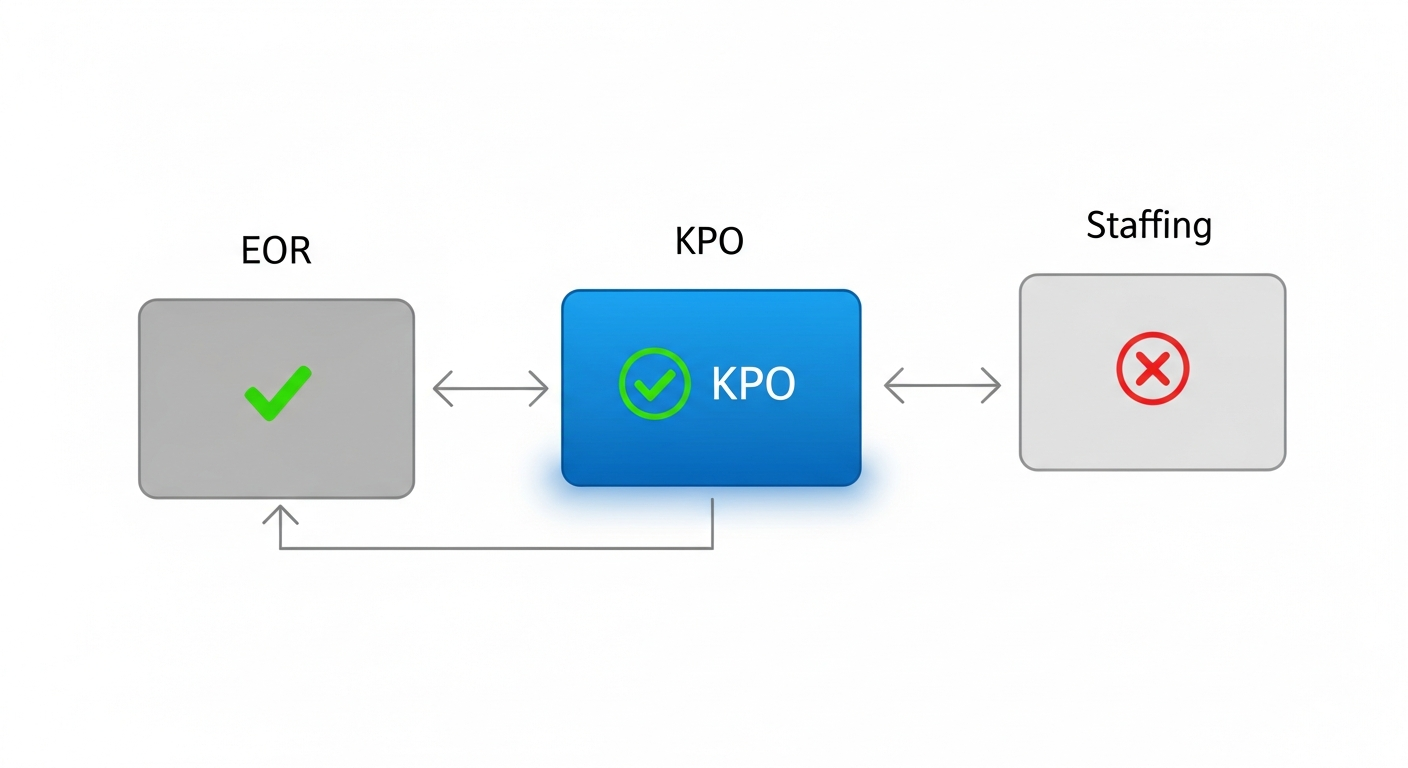
EOR and KPO are both services AQUANEST provides — and they’re not mutually exclusive. Many clients start with a KPO/ODC engagement, identify engineers they want to retain long-term, then convert them to direct hires via EOR. Traditional staffing is the third path — and it’s also the root cause of most software engineering outsourcing problems.
When EOR Is the Right Call
Engineering EOR fits one very specific scenario: you’ve already identified a software engineer you want to hire directly, but you don’t have a local legal entity.
Typical triggers:
- An embedded systems engineer from a KPO engagement impressed you — you want to convert them to a direct hire
- You’ve recruited an AUTOSAR engineer in Vietnam, but your company has no Vietnamese legal entity
- Three months into a KPO engagement, two engineers have proven indispensable — you want to lock them in formally
- You need an engineer stationed long-term at a Tier-1 customer site and need compliant employment
The core value of engineering EOR isn’t cheap labor — it’s bypassing the 3–6 month process of setting up an overseas entity. You’re legally compliant and operational in 2–3 weeks. Labor insurance, pension, and annual tax filings are all handled by the EOR. You own the technical direction.
When KPO / ODC Is the Right Call
KPO fits when you need a team’s capability, not a specific individual.
Typical triggers:
- Standing up a software test automation pipeline — you don’t want to build process and hire from scratch
- An automotive ECU integration project needs 3–5 embedded engineers that simply don’t exist in Taiwan’s market
- Your SI firm is running 8 simultaneous projects and specific delivery windows exceed internal capacity
- You need an AI agent + senior engineer dual-layer architecture to absorb steady incoming code review and regression testing
KPO’s most important differentiator: staff turnover is the vendor’s problem, not yours. Traditional staffing leaves you scrambling to backfill when someone leaves. KPO attrition is absorbed through knowledge documentation and handover — your delivery cadence doesn’t skip a beat.
What’s Actually Wrong with Traditional Staffing
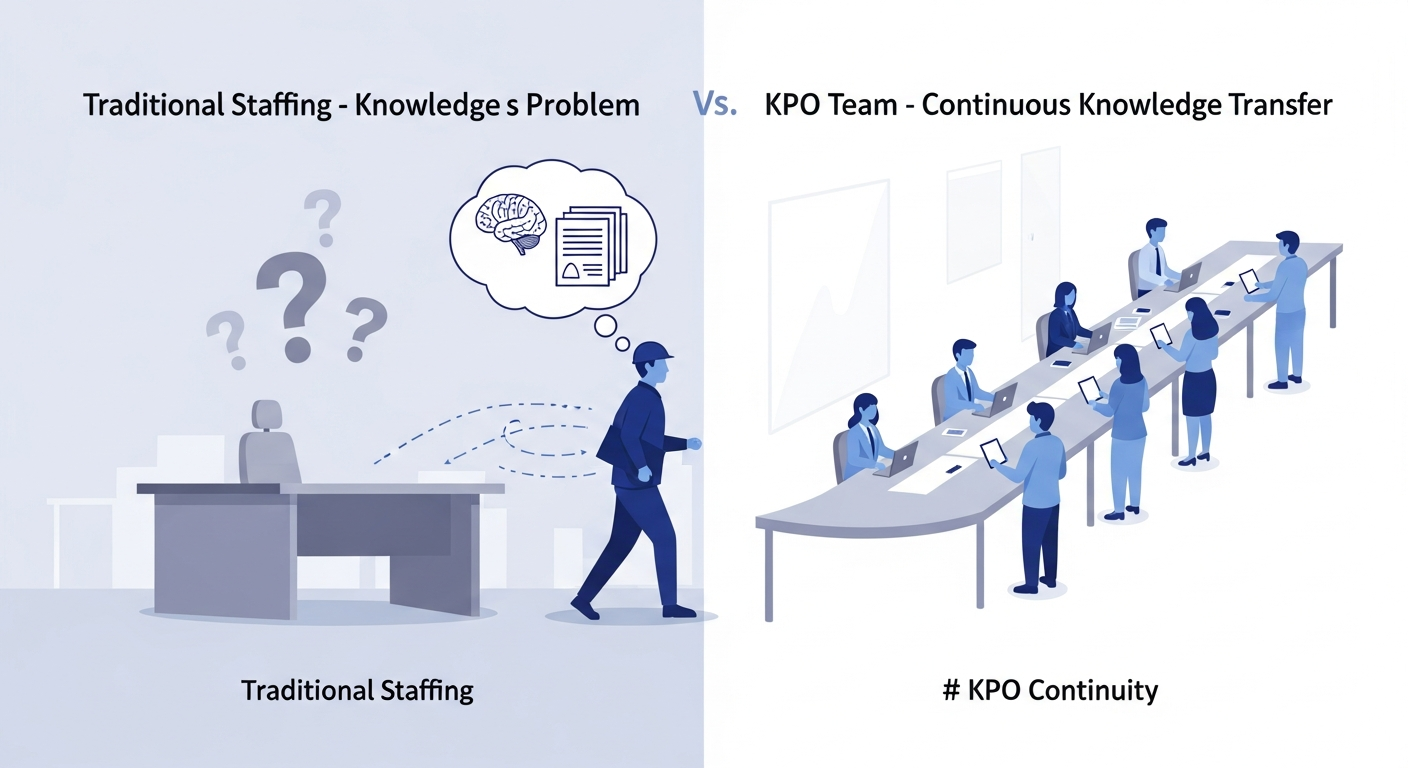
Staffing itself isn’t flawed — applying it to software engineering work is where structural problems emerge:
- High attrition, knowledge walks out the door: When an engineer leaves, three months of domain context leaves with them. The next hire starts from zero.
- The agency controls the relationship: You’re paying, but the agency decides where that engineer’s next contract goes.
- No quality guarantee mechanism: A staffing contract guarantees a body. It doesn’t guarantee capability, process, or output.
- High hidden costs: Management overhead, knowledge transfer, and backfilling all land on you.
Software engineering isn’t a headcount problem. That’s the reason EOR and KPO exist.
Decision Matrix: Which Model for Your Scenario?
| Scenario | Recommended Model | Why |
|---|---|---|
| Found a great engineer, want to hire directly, no local entity | EOR | Compliant hire in 2–3 weeks |
| Need 3+ engineers as a sustained software delivery team | KPO / ODC | Team stability + documented processes — attrition doesn’t derail you |
| KPO engagement uncovered engineers you want to retain long-term | KPO → EOR conversion | Validate capability first, then convert — lowest-risk path to direct hire |
| Clear short-term project (under 3 months), fixed scope | KPO project-based | Fixed deliverables, fixed engagement — no long-term commitment required |
| Building an engineering presence in Vietnam but no entity yet | EOR (Vietnam) | AQUANEST has Vietnam EOR coverage — compliant hire without entity setup |
Three Real-World Cases from Taiwan B2B
Case A: Automotive Tier-2 Supplier
A Taiwan Tier-2 supplier needed 4 AUTOSAR engineers to support ECU integration at a customer site. The Taiwan market had none available; traditional agencies offered general contractors with no automotive background. The team chose AQUANEST KPO — engineers with Tier-1 hands-on experience formed a dedicated team, live in 4 weeks and into the first sprint.
Case B: Semiconductor Equipment — Cross-Border Direct Hire
A US semiconductor equipment company had a Taiwan-based consulting engineer they wanted to convert to full-time. The US parent had no Taiwan entity. Through AQUANEST EOR, the engineer continued working in place — labor insurance, pension enrollment, and contracts signed within two weeks. The relationship formalized without waiting for entity setup.
Case C: SI Firm Elastic Scaling
A Taiwan systems integration firm running multiple factory automation projects hit a severe delivery-window capacity crunch. They adopted AQUANEST KPO on a flexible model: 5 engineers at peak, 2 during slower periods, adjusted monthly. No headcount cost, no recruitment pressure — and the engineers already held deep knowledge of the SI firm’s system architecture.
How Does Pricing Work?
There’s no single “X thousand per month” number because engineering rates vary widely by tech stack and seniority. But here’s a practical reference frame:
- EOR service fee: Typically 10–15% of the engineer’s salary — significantly lower than traditional agency commissions (20–40%)
- KPO engineer cost: 45–65% lower than Taiwan local hiring, depending on tech stack and experience level
- Cost of setting up an overseas entity: 3–6 months + USD 15,000+. That’s what EOR eliminates.
AQUANEST offers a free model selection consultation: bring your requirements and we’ll tell you which model fits, and roughly where costs land.
Frequently Asked Questions
Can we use EOR and KPO at the same time?
Yes — and it’s a common pattern. The typical sequence: start with KPO/ODC to build engineering capability, identify high-performers, then convert them to direct hires via EOR. The two models aren’t mutually exclusive. AQUANEST can manage both within a single engagement framework.
How do EOR engineers integrate with our internal team?
EOR engineers operate inside your existing workflow — same sprints, same code review process, same git repositories. The only difference is that payroll and insurance are handled by AQUANEST. From an engineering process perspective, they’re indistinguishable from internal hires.
What happens if KPO delivery quality falls short?
AQUANEST’s KPO contracts specify clear delivery standards and quality gates — it’s not hourly billing with no accountability for outcomes. If delivery falls short, AQUANEST is responsible for adjusting the team and process. That’s the fundamental difference between KPO and traditional staffing.
Not Sure Which Model Fits? Just Ask.
Most engineering managers encounter these models for the first time without a clear map. AQUANEST offers a free model selection consultation — describe your scenario, budget, and timeline, and we’ll recommend the right path without pushing any particular model.
Free Model Selection Consultation
Tell us about your engineering team’s current situation and scaling goals. We’ll respond within 24 hours with a model recommendation and cost framework — no lengthy forms required.