
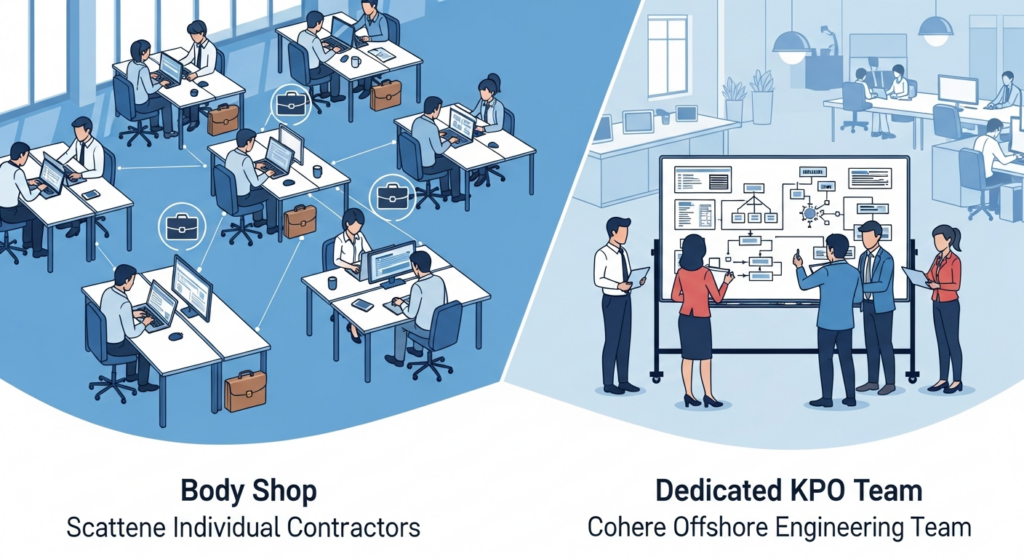
You sign a contract with a staff augmentation firm. Three contract engineers join your Slack. The first two weeks are orientation, access setup, codebase walkthroughs. By week four they’re productive. By week twelve the project wraps, and when they leave, everything they learned leaves with them.
This is the hidden cost of the body shop model: you pay for hours, not outcomes — and you absorb all the management overhead in between.
The alternative isn’t just “offshore engineers who work remotely.” A dedicated offshore engineering team structured as a KPO (Knowledge Process Outsourcing) engagement changes the fundamental contract: deliverables over headcount, retained knowledge over transactional labor, measurable outcomes over logged hours.
What “Body Shop” Actually Means
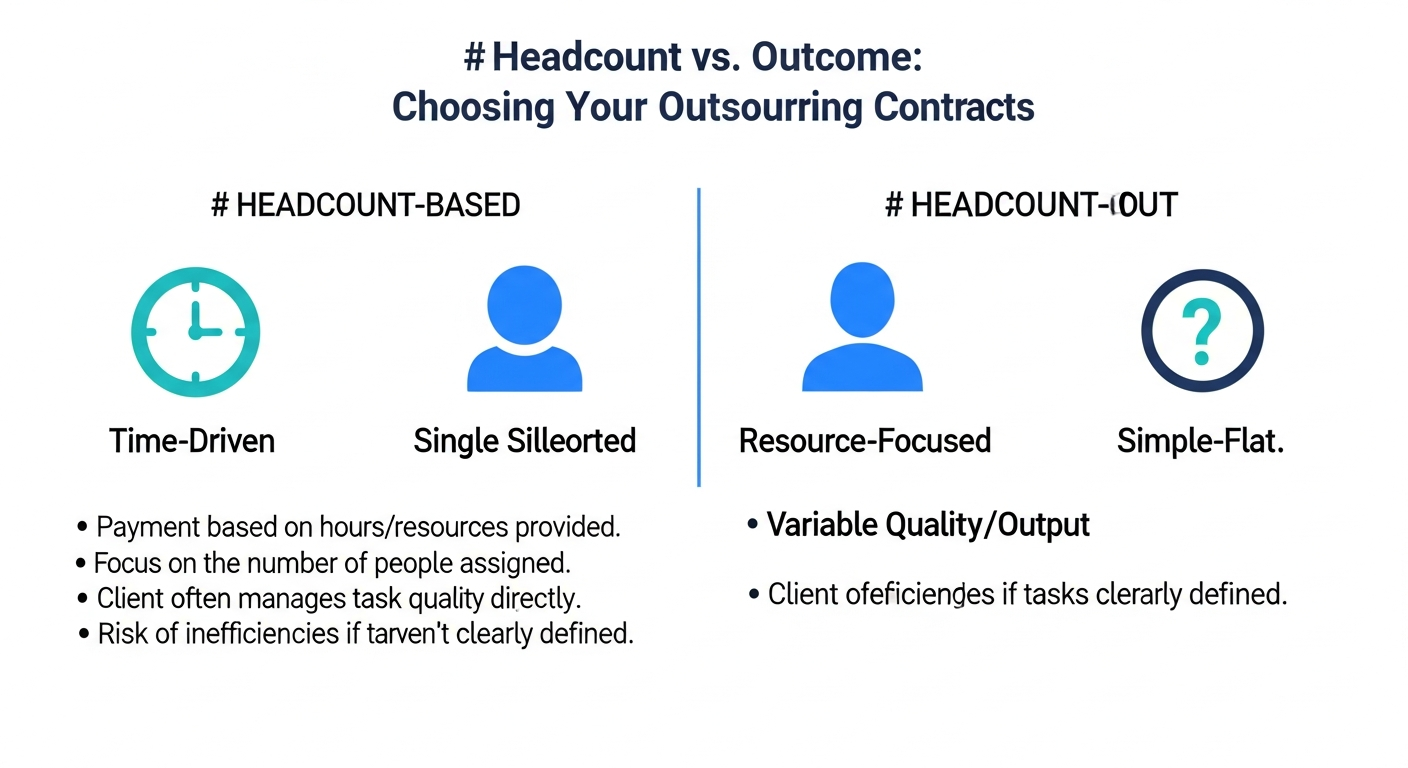
The body shop model — also called staff augmentation or headcount outsourcing — is straightforward: a vendor provides engineers who work under your direction, billing by the hour or day. You own the output, the tools, the architecture decisions, and all the management overhead.
This model has legitimate uses. For a short-term capacity crunch with well-defined, fully-specified work, it moves fast. But it carries structural liabilities that compound over time:
- You manage individuals: Every contractor needs onboarding, task assignment, code review bandwidth, performance oversight — from your team’s time.
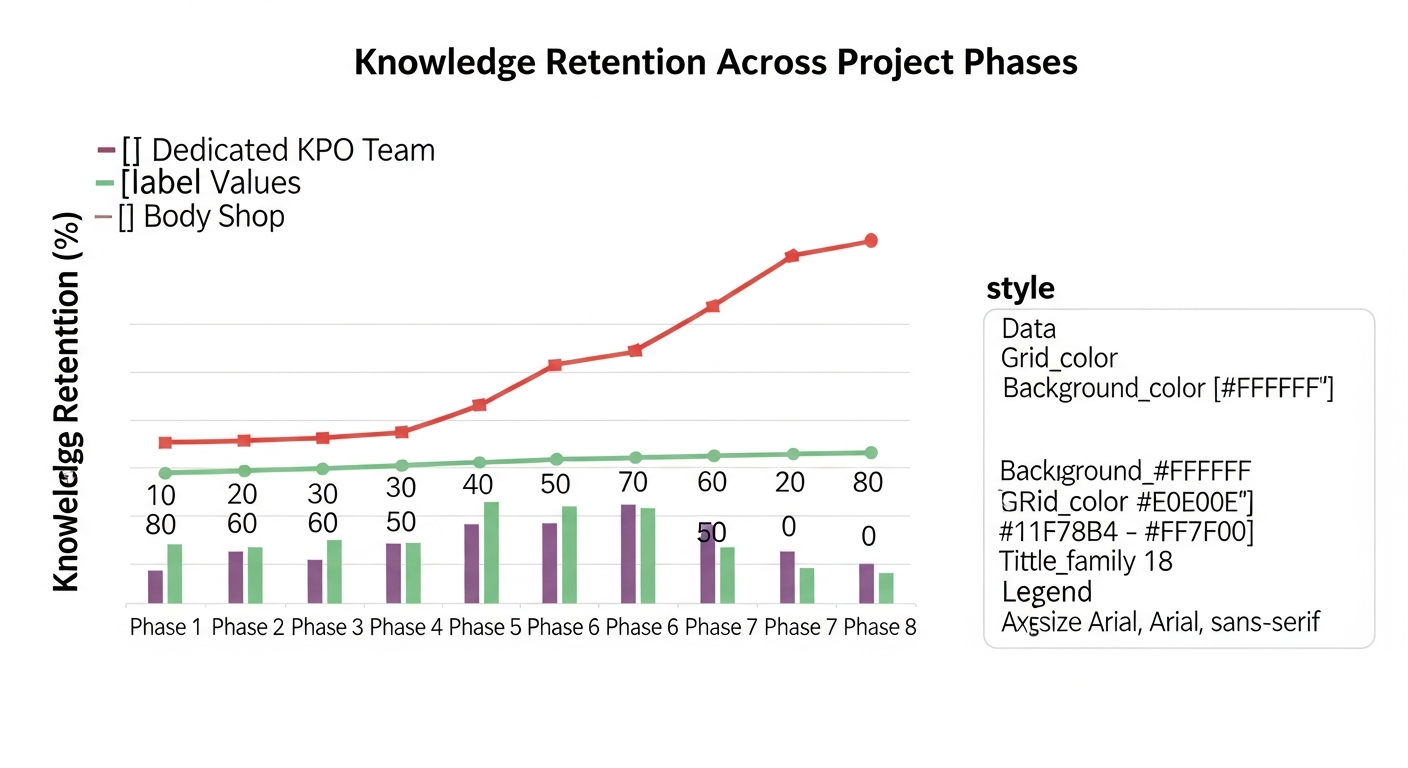
- Knowledge doesn’t compound: When contractors rotate out, they take their project understanding with them. The next batch starts from zero.
- No accountability for outcomes: A body shop invoices for hours worked, not for working software, test coverage, or shipped features.
- IP and process exposure: Individual contractors develop their own style, not your codebase’s conventions. Institutional knowledge fragments across people.
For a one-sprint gap, these trade-offs are acceptable. For sustained engineering work — embedded firmware development, automotive software integration, AI agent deployment — they become structural drag.
What a Dedicated Offshore Engineering Team Delivers
A dedicated offshore engineering team under a KPO structure operates on a different basis. Instead of “here are N engineers, tell them what to do,” the model is: “here is a team with the domain knowledge to own this engineering scope.”
The practical differences:
- Team continuity: The same team leads, engineers, and QA specialists work across your projects. Knowledge of your system architecture, customer requirements, and quality standards is retained at the team level — not lost when an individual leaves.
- Outcome-based contracts: Deliverables are specified — firmware module with defined test coverage, AI agent handling a documented use case, test automation suite covering X features. You pay for the outcome, not the hours it took.
- Domain specialization: A KPO team focused on embedded and automotive software brings relevant context (BSP layer patterns, AUTOSAR conventions, ISO 26262 process awareness) without a multi-week ramp-up from scratch.
- Built-in quality gates: Code review, CI integration, and documentation are part of the engagement, not extras you have to specify.
Five Reasons Outcome-Based Beats Headcount-Based
1. Management Overhead Collapses
With a body shop, you effectively manage N extra engineers — task assignment, standup coordination, PR reviews, context updates. With a dedicated KPO team, you manage one engagement lead. That single interface handles internal team coordination, escalation paths, and progress reporting. For engineering managers already stretched across roadmap, hiring, and technical debt, this is a significant load reduction.
2. Knowledge Compounds Over Time
A dedicated team builds a mental model of your system over multiple projects. By the third engagement, they know your communication protocol quirks, your customer’s factory environment constraints, your implicit quality bar. That accumulated context translates directly to faster delivery and fewer integration surprises — it’s an asset that appreciates, not a perishable service.
3. Quality Accountability Is Real
When the contract is outcome-based, the vendor has skin in the game for quality. Delivered firmware that fails smoke tests means rework on their time. Delivered test automation that doesn’t catch regressions is a contract breach, not an acceptable hour log. This alignment of incentives doesn’t exist in a headcount model where the invoice is based on time regardless of output quality.
4. Faster Effective Ramp-Up
The body shop ramp-up cost is borne entirely by the buyer: access provisioning, codebase orientation, toolchain setup, process alignment. A domain-specialized KPO team still requires project-specific onboarding, but arrives with the foundational knowledge — embedded Linux patterns, automotive software conventions, AI agent deployment experience — already in place. Week one is alignment, not basics.
5. Cost Predictability
Outcome-based engagements scope deliverables with defined effort envelopes. You know what you’re getting and at what cost before the engagement starts. Headcount billing accumulates in ways that are hard to predict — scope creep in hours is invisible until the invoice arrives. Fixed-scope KPO engagements let you plan, budget, and manage engineering spend as a controlled variable.
When Body Shop Still Makes Sense
To be direct: there are scenarios where staff augmentation is the right tool.
- Short-term capacity gaps (1-2 sprints) where the work is fully specified and your team can absorb the management overhead
- Roles where judgment and domain knowledge are primarily internal and the external contribution is well-scoped execution
- Situations where you need maximum flexibility to scale headcount up or down on short notice
The model breaks down when the work is complex, sustained, or knowledge-intensive — where the engineering judgment, accumulated context, and quality accountability matter as much as the raw hours.
Dedicated Offshore Team Use Cases in Taiwan’s B2B Engineering Sector
Taiwan’s embedded and automotive software sector — Tier-1/2 suppliers, semiconductor equipment manufacturers, smart manufacturing system integrators — runs on exactly the type of engineering work where dedicated KPO teams outperform body shops:
- Automotive ECU and ADAS software: Sustained firmware teams that understand AUTOSAR, CAN/Ethernet protocol stacks, and ISO 26262 process requirements produce better outcomes than rotated contractors who rebuild context each engagement.
- Semiconductor equipment embedded control: BSP customization, device driver development, and real-time control software require deep familiarity with the hardware platform — knowledge that lives in a stable team, not in contractor individual notes.
- Smart manufacturing MES and AI integration: Factory floor software touches safety-critical systems, legacy PLCs, and complex data pipelines. A dedicated team that has worked with your architecture before is not a luxury — it’s a risk management decision.
- Test automation for regulated industries: Building and maintaining test automation suites that actually catch regressions requires understanding the software’s failure modes. This knowledge compounds; it cannot be rebuilt from scratch each engagement.
AQUANEST delivers production-ready engineering in 6-8 weeks. AI agents handle first-line triage; senior engineers handle second-line judgment work.
Talk to us about scoping your first engagement →
How AQUANEST Structures Dedicated Engineering Engagements
AQUANEST operates as a KPO partner for Taiwan’s B2B engineering sector — not a staffing vendor. The structural difference shows up in how engagements are defined and delivered:
- Outcome-first scoping: Before any engineer is assigned, we define what “done” looks like: which functionality, what test coverage, which integration points. The engagement is anchored to deliverables, not to headcount.
- AI-augmented delivery: Our engineering teams use AI agents for first-line work — document parsing, code review automation, test case generation, specification analysis. Senior engineers focus where judgment is required, not on repeatable cognitive tasks.
- Knowledge retention by design: Dedicated teams maintain an internal knowledge base of your system context. Engineer transitions don’t reset project understanding to zero.
- 6-8 week production-ready delivery: Our first-delivery target is working software in your environment, not a status update deck.
For related reading on the hiring model comparison, see: Engineering EOR vs KPO vs Staffing: A CTO’s Guide to Hiring Software Engineers in Taiwan. For the cost comparison between in-house and KPO models: The Hidden Cost of In-House Engineers: Why More CTOs Choose KPO.
The Right Question to Ask Before Your Next Outsourcing Decision
The question isn’t “should we use offshore engineers?” Most engineering leaders have already answered yes. The question is: are we paying for hours, or for outcomes?
If the answer is hours, you’re running a body shop model — and absorbing the management overhead, knowledge volatility, and quality risk that comes with it. If the answer is outcomes, you need a partner structured to own them: defined deliverables, domain knowledge, accountability across the engagement.
For sustained, complex engineering work in Taiwan’s embedded, automotive, and AI software sector, dedicated offshore teams with KPO structure consistently outperform headcount-based alternatives. The math is straightforward; the model decision is what most teams get wrong.
Contact AQUANEST to scope a dedicated engineering engagement →