Introduction
If your engineering team is stretched thin, your product roadmap is slipping, and hiring local talent feels like an impossible budget battle — you’re not alone. Thousands of tech companies in 2026 are turning to knowledge process outsourcing (KPO) to close the gap between what their business needs and what their in-house team can realistically deliver.
But KPO is not the same as traditional outsourcing. It’s not about handing off repetitive tasks to a call center. KPO is about accessing a team of specialized, high-skill engineers who become a seamless extension of your own R&D — handling complex software development, embedded systems, testing, and technical problem-solving that requires real expertise.
This guide explains exactly what KPO is, how it differs from other outsourcing models, and how to decide if it’s the right move for your company in 2026.

What is Knowledge Process Outsourcing (KPO)?
Knowledge process outsourcing is the practice of delegating high-expertise, knowledge-intensive work to an external team — typically offshore — that has specialized skills your internal team lacks or cannot cost-effectively scale.
Unlike Business Process Outsourcing (BPO), which handles standardized, repetitive processes (data entry, customer support, billing), KPO deals with work that requires domain expertise, analytical judgment, and technical depth. Examples include:
- Software R&D and embedded systems engineering
- Automotive software development (ADAS, Smart Cockpit)
- QA architecture and test automation strategy
- System integration and hardware-software co-design
- Industrial IoT firmware and protocol implementation
In short: if the work requires a senior engineer to think through a problem — not just execute a script — it falls under KPO.
KPO vs BPO vs ODC: What’s the Difference?
These three terms are often confused. Here’s a simple breakdown:
| Model |
Work Type |
Skill Level |
Engagement Style |
| BPO |
Repetitive, process-driven |
Low to mid |
Transactional |
| KPO |
Knowledge-intensive, analytical |
Mid to senior |
Collaborative |
| ODC |
Dedicated R&D team, client-managed |
Mid to senior |
Embedded |
KPO providers are domain specialists. An ODC (Offshore Development Center) is a structural model — a dedicated team that sits within the KPO partner’s facility but operates under your direction. Many companies use KPO and ODC together for maximum flexibility.
Why 2026 is the Golden Era for KPO
Several macro trends have converged to make knowledge process outsourcing more valuable — and more accessible — than ever before.
1. Supply Chain Disruption is Forcing Business Diversification
The US-China trade tensions, ongoing tariff escalations, and geopolitical uncertainty have pushed multinational companies to rethink their operational concentration. Just as manufacturers are diversifying their physical supply chains, tech companies are diversifying their engineering talent supply chains. KPO in stable, high-capability regions like Taiwan offers a strategic alternative to over-relying on any single geography.
2. Western Engineer Salaries Have Become Unsustainable
In the US, a senior embedded software engineer now commands $160,000–$220,000 per year in base salary alone, before benefits, equity, and management overhead. For a mid-sized hardware company needing to staff up a 5-person software team, that’s over $1 million annually — before the team ships a single line of production code. KPO partners in Asia can deliver equivalent technical output at 40–60% of that cost, without sacrificing quality.
3. AI Tools Have Eliminated the Remote Collaboration Barrier
Three years ago, managing an offshore team meant timezone frustration, slow code reviews, and communication gaps. In 2026, AI-assisted development tools, async-first workflows, and real-time translation have fundamentally changed the equation. Distributed teams now operate with the coordination efficiency that once required everyone in the same room. The “remote = slower” assumption no longer holds.
4. The Embedded and Automotive Software Market is Exploding
The electric vehicle transition and rise of AI-driven driver assistance systems (ADAS) has created an acute shortage of engineers who understand both software and hardware constraints. Traditional automotive OEMs and Tier 1 suppliers are scrambling to staff software teams while managing legacy hardware engineering culture. KPO partners with embedded specialization are filling a gap that hiring alone cannot solve fast enough.
What Types of Work Can KPO Handle?
A mature KPO partner can take on a wide range of technical work, including:
Software R&D
- Feature development for embedded Linux / RTOS platforms
- SDK and middleware development
- Android Automotive OS customization
Automotive & ADAS
- ADAS algorithm integration and validation
- Smart Cockpit HMI development
- ISO 26262 functional safety documentation support
System Integration
- Hardware-software co-design support
- Board bring-up and driver development
- Protocol implementation (CAN, LIN, Ethernet, SOME/IP)
Software QA & Testing
- Test plan architecture
- Automated regression testing
- HIL (Hardware-in-the-Loop) test support
The key differentiator: KPO teams don’t just execute tickets. They understand the why behind the architecture, flag risks early, and bring genuine engineering judgment to the engagement.

How KPO Works: A Typical Engagement
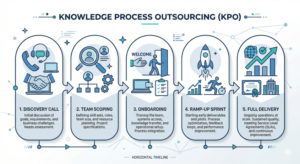
Here’s what a KPO engagement looks like from first contact to ongoing delivery:
- Discovery Call — You describe your technical challenge, current team structure, and timeline pressure. The KPO partner assesses fit and proposes an engagement model.
- Team Scoping — Based on your needs, a dedicated team profile is built: 2 senior engineers + 1 QA + 1 tech lead, for example.
- Onboarding — The KPO team integrates into your toolchain (Jira, GitHub, Confluence), attends sprint planning, and gets aligned on coding standards and architecture.
- Ramp-up Sprint — A short 2-4 week period where the team shadows your processes, asks deep technical questions, and produces first deliverables for quality calibration.
- Full Delivery Mode — The team operates like a remote engineering pod: regular standups, async code reviews, weekly demos, and direct Slack/Teams communication with your internal leads.
- Knowledge Transfer — At any project phase, documentation and architecture decisions are maintained so your internal team retains full IP and context.
What to Look for in a KPO Partner
Not all KPO providers are equal. When evaluating partners, CTOs and VP Engineerings consistently prioritize three things:
Technical Depth, Not Generalism
Beware of KPO vendors who claim to do everything. The best partners have a clear specialization — whether that’s automotive software, embedded Linux, or IoT firmware. Deep expertise means faster ramp-up, fewer mistakes, and engineers who can genuinely contribute to architecture decisions.
Proven IP Protection
IP leakage is the #1 concern for hardware companies considering offshore development. Ask specifically: What NDA structures do you use? How is code repository access controlled? Have you worked with clients who filed patents on jointly developed IP? The answer should be detailed and confident.
Timezone-Compatible Communication
For US clients, East Asia (UTC+8) offers a 3-5 hour overlap with Pacific time in the morning. For European clients, the overlap is smaller but manageable with async-first discipline. Ask the KPO partner about their communication cadence and how they handle urgent blockers when timezones diverge.
Is KPO Right for Your Company?
KPO is likely a strong fit if:
- You have a defined engineering need but can’t justify a full-time headcount
- Your roadmap requires specialized skills (embedded, ADAS, Android Automotive) that are hard to hire locally
- You need to accelerate a release without burning your existing team
- Your budget can support offshore talent at 40-60% of local cost
- You’re open to a collaborative, transparent engagement model
KPO may not be the right fit if:
- Your work requires constant physical presence (lab testing, hardware prototyping hands-on)
- You have no internal technical lead to interface with the offshore team
- Your IP is so sensitive that any external access is off the table
How AQUANEST Approaches KPO
AQUANEST is a KPO and ODC provider based in Taiwan, specialized in embedded software, automotive systems, and hardware-integrated software development. Our engineering team has delivered projects for clients in automotive, industrial automation, and consumer electronics — working within supply chain cultures shaped by Toyota, Bosch, and global Tier 1 standards.
What makes our approach different:
- No generalist staffing. We work only in our areas of deep expertise.
- IP-first engagement. Every engagement begins with airtight NDA and access control setup.
- Senior-weighted teams. Our default engagement model leads with senior engineers, not junior staff padded with managers.
- Taiwan-based stability. Geopolitically stable, technically mature, and aligned with global quality standards.
Explore our KPO services at aqnest.com/kpo/ or learn how we combine KPO with a dedicated ODC structure for larger engagements at aqnest.com/odc-kpo/.
Ready to Explore KPO for Your Team?
If your engineering roadmap is under pressure and you’re curious whether a KPO partner could help — the best next step is a 30-minute technical discovery call. No sales pitch, no commitment. Just a conversation about your challenge and whether we’re the right fit.
Contact AQUANEST to schedule a discovery call