
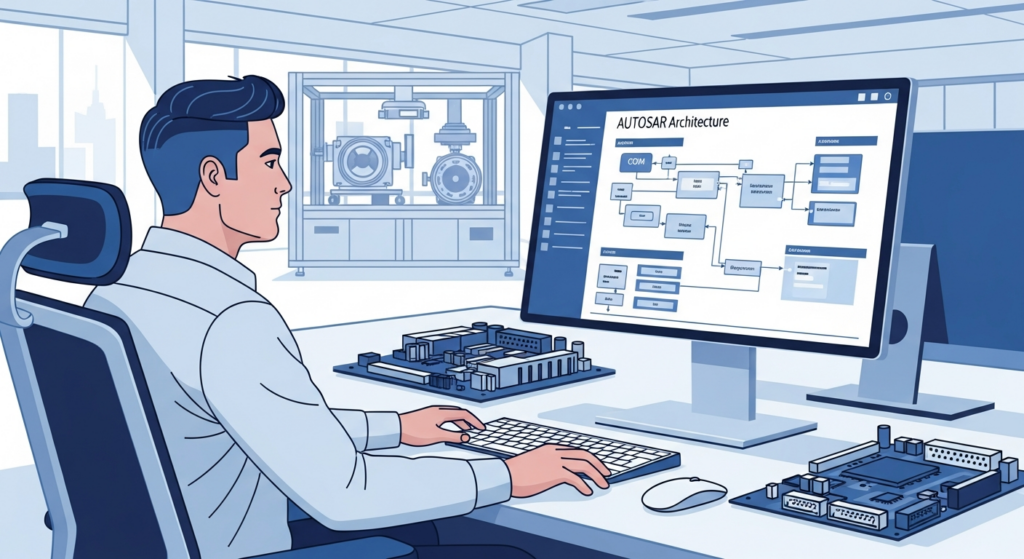
Taiwan’s Tier-1 automotive electronics suppliers are running into the same wall: they need embedded software engineers with AUTOSAR experience, firmware verification skills, and enough automotive context to work inside a customer’s development environment — and they can’t hire them fast enough.
Headhunting takes six to nine months, often longer for automotive specialists. Staff augmentation firms send engineers who need three months of onboarding before they’re useful. Meanwhile the engineering roadmap doesn’t pause.
Automotive software talent outsourcing — specifically, the co-location model that places AQUANEST engineers on-site at customer facilities — is how Taiwan’s Tier-1 suppliers are closing that gap without the delays and overhead of traditional hiring.
The Embedded Software Talent Gap in Automotive Tier-1
The automotive software stack has grown faster than the talent pipeline. A modern ADAS ECU or connected cockpit system involves AUTOSAR-Classic middleware, CAN/Ethernet protocol stacks, functional safety requirements under ISO 26262, and hardware-in-the-loop (HIL) testing infrastructure. Engineers who can work across that full stack are rare, expensive, and in demand from OEMs and Tier-1s simultaneously.
Taiwan’s Tier-1 suppliers face a specific version of this problem: their customers — international OEMs, global Tier-0s — increasingly require on-site collaboration at customer facilities. Not remote work. Not occasional visits. Engineers embedded in the customer’s team, working in the customer’s development environment, aligned to the customer’s safety standards and toolchains.
Traditional hiring can’t solve this quickly. EOR agreements help with compliance but don’t close the competency gap. Staff augmentation provides bodies, not automotive-domain-ready engineers.
Co-Location Is Not Remote Work
Co-location means AQUANEST engineers work at the customer’s physical site — same office, same tools, same design reviews, same sprint cadence. This isn’t a remote engagement with frequent site visits. It’s a sustained on-site presence.
The distinction matters for automotive software development because:
- Hardware access is non-negotiable: Embedded firmware development requires direct access to evaluation boards, HIL rigs, and diagnostic tools. Remote access is a workaround; on-site access is the standard.
- Real-time collaboration resolves issues faster: System-level integration problems in automotive ECUs are often solved by engineers who can physically gather around a test bench — not by asynchronous messages.
- Customer security requirements: Many Tier-1 customers have strict data handling and IP requirements that prevent remote access to development systems entirely.
- AUTOSAR configuration complexity: Variant handling, static code analysis, and safety requirement tracing require continuous coordination with the OEM’s systems engineers — a density of interaction that remote setups struggle to sustain.
How AQUANEST Co-Location Works
AQUANEST’s co-location model is structured to minimize the gap between “engineer arrives on-site” and “engineer delivers production-quality work.” The typical engagement runs in four phases:
- Scope alignment (Week 1–2): Define what the engineer owns — specific ECU components, test suites, integration tasks. Not “help where needed” — a defined scope with measurable completion criteria.
- Environment setup (Week 2–3): AQUANEST engineers arrive pre-familiar with standard automotive toolchains (AUTOSAR BSWs, Vector tools, TESSY, Polyspace). Customer-specific onboarding covers variant configuration and team conventions, not tool basics from scratch.
- Active delivery (Week 3 onward): Engineers participate in daily standups, sprint reviews, and design sessions as full members of the customer’s development team.
- Knowledge retention (ongoing): Unlike staff augmentation, AQUANEST maintains structured documentation — institutional knowledge of the engagement stays accessible even as team composition evolves.
AQUANEST specializes in automotive software co-location across Taiwan, including on-site presence at Tier-0 and OEM sites.
Start a free scoping conversation →
Case Study: A Tier-1 Automotive Electronics Integrator in Taiwan
A Taiwan-based Tier-1 automotive electronics supplier won a multi-year embedded software contract with an international OEM. Their in-house engineering team had project management bandwidth but lacked the firmware and testing specialists required for the specific ECU platform.
The challenge:
- Customer required engineers on-site at its Taiwan facility — remote was not accepted
- OEM toolchain included TESSY for unit testing and ModusTool for embedded development
- Timeline: engineers needed within 30 days, not the 6–9 months typical for specialized automotive hires
- The customer’s sprint cadence was already running — onboarding time had to be short
AQUANEST deployed co-located engineers within four weeks. The engagement structure:
- Engineers arrived with existing familiarity with automotive testing frameworks and embedded C development
- Fully integrated into daily standups and sprint reviews at the customer facility from day one
- First deliverables — TESSY test case suites and ModusTool component builds — completed within six weeks of arrival
- Ongoing co-location supporting continuous ECU development and future platform work
The result: faster time-to-productivity than any alternative sourcing path, without the IP risk or transition complexity of full-time hires who might leave after acquiring project-specific knowledge.
When Co-Location Is the Right Model
Co-location is the right choice when:
- Customer requires on-site presence: OEMs and global Tier-0s increasingly mandate this for embedded development contracts — it’s becoming a baseline requirement, not a preference.
- Hardware access is non-negotiable: Firmware, BSP, and HIL testing can’t be done remotely without significant infrastructure investment that typically isn’t justified for project-length engagements.
- Speed matters more than lowest unit cost: A co-located engineer producing results in week three beats a remote engineer still ramping in week twelve.
- The engagement is continuous, not one-time: ECU maintenance, regression testing, and feature development cycles are well-suited to co-location — the sustained relationship pays for itself over multiple delivery cycles.
When remote ODC or offshore KPO is a better fit: purely software-layer work such as application-level Android Automotive or cloud backends, large-scale specification writing, or test automation framework development that doesn’t require physical hardware access.
Related reading: Dedicated Offshore Engineering Team vs Body Shop: Why Outcome-Based Beats Headcount-Based KPO and Cross-Border Engineer Hiring 2026: Why Taiwan EOR Beats Deel/Remote for Embedded & Automotive Software.
Cost and Timeline at a Glance
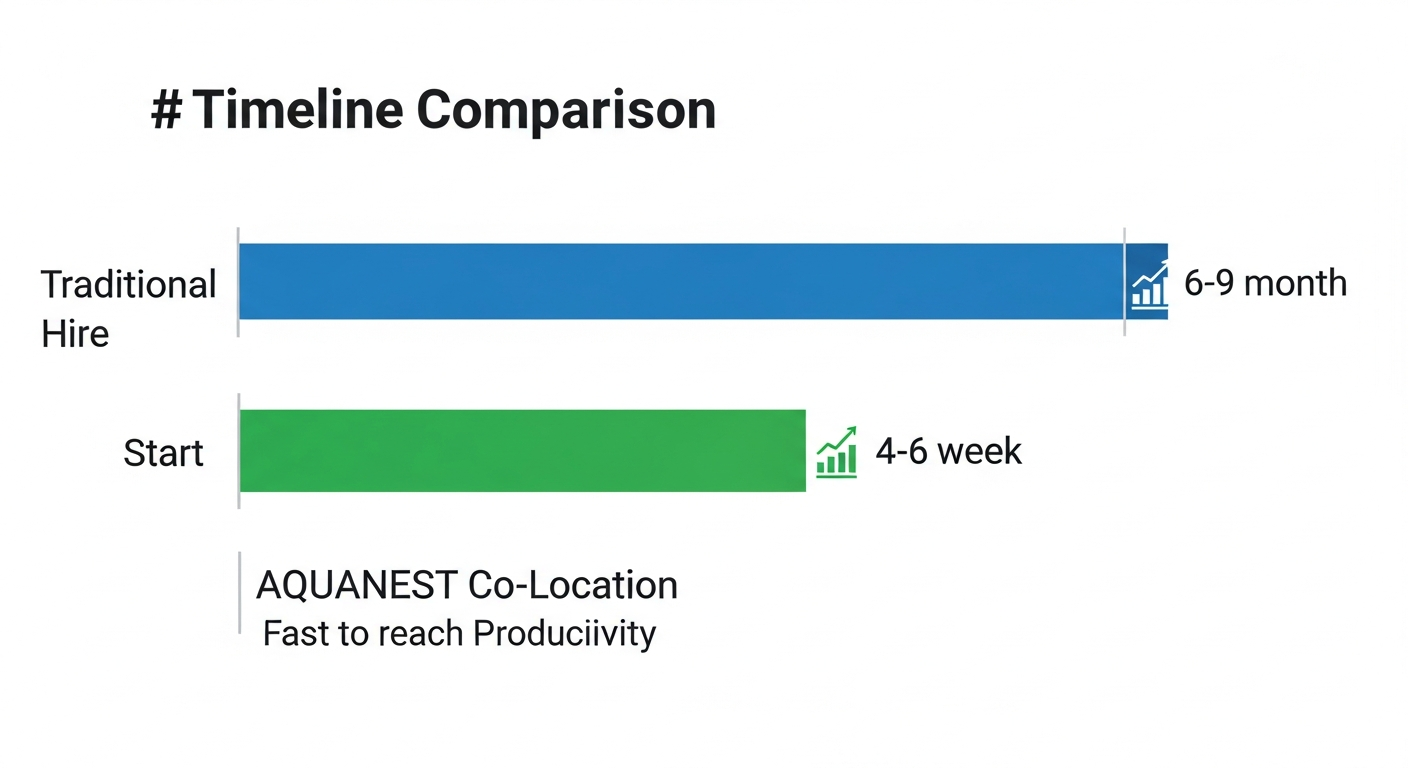
Co-located automotive software engineers through AQUANEST’s KPO model typically run 30–40% lower than equivalent full-time Taiwan hires when total employment cost is considered — benefits, recruitment, and turnover risk included. Against equivalent-experience engineers sourced through traditional headhunting:
- Time-to-productive: 4–6 weeks vs. 6–9 months for a hired engineer
- Management overhead: AQUANEST manages the engineer’s scope and quality; your team manages the outcome
- Continuity risk: AQUANEST absorbs turnover — if an engineer leaves, the knowledge documentation stays with the engagement
- Scalability: Expand or reduce headcount by project phase without the legal and HR complexity of direct employment changes
Frequently Asked Questions
How quickly can AQUANEST deploy co-located engineers?
Typically 3–5 weeks for engineers with existing automotive toolchain familiarity. Complex customer security clearance requirements may extend this timeline. Contact us to discuss your specific situation.
What toolchains do AQUANEST co-located engineers typically know?
Commonly: AUTOSAR-Classic and Adaptive BSW, Vector CANalyzer/CANoe, TESSY unit testing, Polyspace static analysis, ModusTool, Keil/IAR embedded development environments, and DOORS for requirements tracing. Specific toolchain fit is confirmed in the scoping conversation.
How does this differ from a staffing agency?
A staffing agency places an individual under your management and direction — all quality, pace, and output accountability sits with you. AQUANEST co-location is a KPO engagement: defined scope, outcome accountability, knowledge retention structure, and a single engagement lead who manages the engineering work. You manage the outcome, not the individual. Start a scoping conversation with AQUANEST →